
The complete industrial modular cabinet specification guide
Specifying the right industrial modular cabinet system ensures you get a solution built for your exact needs. This checklist breaks down the process into six simple steps to get you started.
- Define your application: What are you storing? Make a list of your items, such as tools, small parts, electronics, or bulk supplies, to understand your storage requirements.
- Measure your space: Determine the maximum available height, width, and depth for the cabinet. This ensures a perfect fit in your workspace. Don’t forget about overhead clearance. When measuring your space, account for sprinklers, lighting fixtures, and any overhead utilities. The cabinet must fit, but you also need to ensure it doesn’t violate fire codes or obstruct essential building systems.
- Select a housing: Choose the foundational cabinet shell. Base your selection on your dimensions and the total weight capacity needed for your application.
- Configure the interior: This is the modular advantage. Mix and match drawers, dividers, and bins to create a custom layout that organizes your specific items.
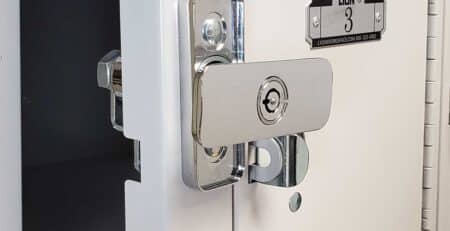
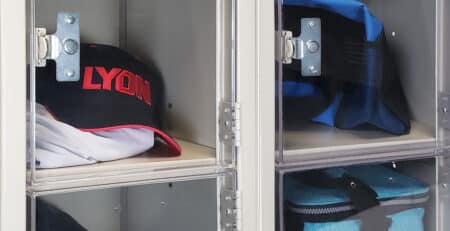
- Choose security & access: Select the right door style, such as solid steel for security or clearview for visibility, and choose a locking mechanism that meets your access control needs.
- Add accessories: Finalize your custom cabinet system with options like a mobile base for portability, a durable worktop, or drawer dividers for even better organization.
Why choose a modular system?
While a standard, all-welded cabinet offers static storage, an adaptable modular cabinet system delivers a strategic advantage through superior flexibility and efficiency. Unlike a fixed cabinet, a modular system is a configurable solution you can adapt as your needs change, making it a smarter long-term investment.
For facilities using lean manufacturing principles like 5S, modular cabinets are a perfect fit. The high-density, organized storage directly supports the ‘Set in Order’ (Seiton) and ‘Standardize’ (Seiketsu) steps by ensuring there is a specific, labeled home for every tool and part.
Adaptability & future-proofing
Your storage needs today might not be the same next year. The primary benefit of a modular cabinet is its ability to adapt. You can easily reconfigure the interior by adding, removing, or rearranging dividers and partitions. This ensures your cabinet system continues to serve its purpose effectively, protecting your investment for years to come.
Space efficiency
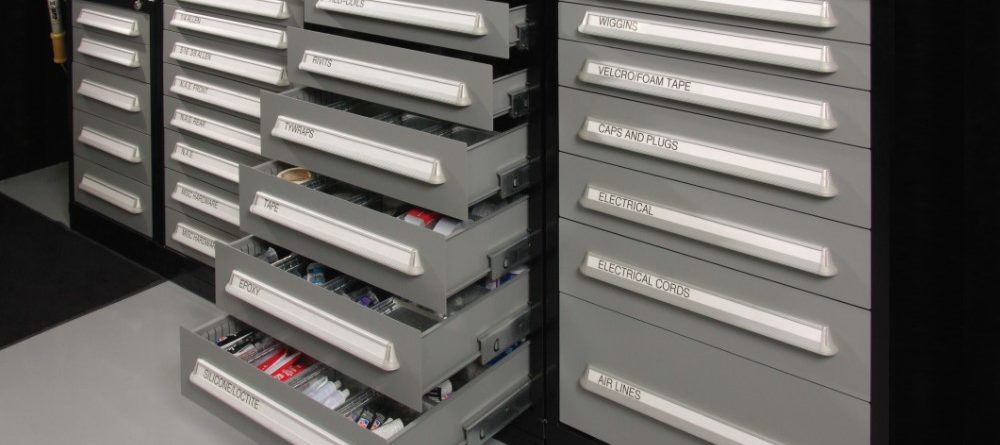
Industrial floor space is valuable. Modular systems are designed to maximize storage density, allowing you to store more in a smaller footprint. By using partitioned drawers instead of open shelving for small to medium items, you can dramatically reduce wasted space.
Think of modular drawers as micro-managing your space. Instead of a large, open shelf where small items get lost, a drawer with partitions creates a specific ‘address’ for every single part. This ‘addressability’ is the key to faster picking times and virtually eliminates the ‘I can’t find it’ problem, boosting operator efficiency by up to 50%. This level of organization improves inventory control, reduces search time, and helps your team retrieve items faster, boosting overall productivity.

Application-specific solutions
One size rarely fits all in an industrial environment. Modularity allows you to create a purpose-built cabinet for a specific task. You can design the perfect CNC tool storage station, a mobile maintenance cart, or a high-density parts depot by combining different storage components like drawers, shelves, and bins all within a single, efficient housing.
The anatomy of a heavy-duty modular cabinet
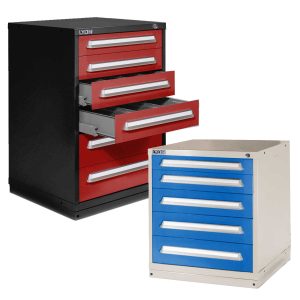
Understanding the components of a modular cabinet helps you specify a system that is truly built to last. From the foundation to the finishing touches, each part plays a key role in performance and durability.
The cabinet housing: the foundation of your system
The housing is the cabinet’s framework, providing the strength and structure for the entire unit.
- Construction: Lyon’s all-welded steel housing offers superior strength and rigidity right out of the box compared to bolt-together designs that can loosen over time.
- Material: We use heavy-gauge steel to ensure our cabinets can handle the toughest industrial applications. Steel gauge refers to its thickness; a lower gauge number means thicker, more durable steel.
- Key specification: The overall load capacity of the housing is essential. Our standard housings are designed to support thousands of pounds of stored materials.
Modular drawers: high-density & organized storage
Drawers are the key to organized, high-density storage for tools and parts.
- Suspension systems: Our drawers feature heavy-duty ball-bearing slides that provide smooth, quiet operation even under a full load, ensuring longevity and ease of use.
- Drawer capacity: Each standard modular drawer is rated for an impressive 400 lbs capacity, allowing you to confidently store heavy tools and components.
- Full extension: 100% full-extension drawers are essential. They allow you to access the entire drawer, making every item visible and easy to reach without rummaging.
- Layout kits: Drawer partitioning accessories are what make modular drawers so efficient. You can use dividers, partitions, and bins to create custom compartments for every single item.
Adjustable shelving: for bulk & varied items

For larger items, supplies, or equipment, adjustable shelves offer versatile storage.
- Shelf capacity: Each shelf is engineered with a specific load rating to safely support heavy or bulky materials.
- Adjustability: Shelves can be adjusted on defined centers, giving you the flexibility to change shelf height to accommodate items of various sizes.
- Reinforcement: For the heaviest applications, reinforced “pan” style shelves provide extra rigidity and prevent deflection under load.
Base & mobility options
The base determines how your cabinet interacts with your workspace.
- Forklift base: A forklift-ready base allows for easy and safe movement and placement of a fully loaded cabinet within your facility.
- Mobile base: You can add heavy-duty casters to create a mobile workstation or tool cart.
A 5-step guide to specifying your perfect modular cabinet
Follow this straightforward guide to configure a cabinet system tailored to your exact application.
Step 1: Assess your storage requirements & application
First, define what you need to store and how you will use the cabinet.
- What are you storing? Check all that apply: small parts, heavy tools, fasteners, sensitive electronics, bulk items, manuals, or tooling.
- Inventory your items:
- Measure the dimensions of your largest and smallest items.
- Estimate the total weight of the items you plan to store in each drawer or on each shelf. A common mistake is underestimating the total weight. Always calculate the ‘worst-case scenario’ weight for each drawer and the entire cabinet. This ensures you specify a cabinet with a sufficient load capacity, preventing premature wear, suspension failure, or a dangerous tipping hazard. Safety should always be the first consideration.
- Determine if items need to be separated into individual compartments.
- Define the application: Will this cabinet be used in a tool crib, as a maintenance, repair, and operations (MRO) station, on a production line, or in a warehouse? When considering cabinet placement, think about workflow. Cabinets holding frequently used items should be placed at ‘point-of-use’, right where the work happens. For less frequently accessed items, placing cabinets in a centralized storage area is more efficient.
Step 2: Select the right cabinet housing
With your requirements defined, choose a housing that fits your space and application.
- Choose by dimensions: We offer standard widths like 30″, 46″, and 60″. The ‘Double-Wide’ housing (60 inches) is a game-changer for storing long items like shafts, bar stock, or specialized tooling. It also allows you to combine high-density drawer storage and bulk shelving within one extra-large unit, creating an all-in-one storage station.
- Choose by height: Select from counter-height, eye-level, or bench-height housings to match your workflow. Eye-level housings are often overlooked but are incredibly ergonomic. They position frequently used drawers and shelves between waist and shoulder height, reducing the need for workers to bend or reach excessively. This minimizes strain and fatigue, which is a significant factor in workplace safety and productivity.
- Pro tip: We recommend starting with a standard 30-inch wide, counter-height housing for most applications, as it provides the most configuration flexibility.
Step 3: Configure the interior components
Now, customize the inside of the cabinet to match your inventory.
- Drawer selection: Match the drawer height to the items being stored. Use low-profile drawers for hand tools and gauges, and deeper drawers for larger power tools or kits. Drawer heights are critical. You want to match the drawer height to the items stored. Storing 1-inch tall tools in a 6-inch high drawer wastes 5 inches of vertical space. It’s like stacking empty boxes. Maximizing your ‘cubic space’ means minimizing this wasted air. Choose drawers that are 1/2″ to 1” taller than the stored items to allow for proper clearance.
- Shelf vs. drawer: Use this simple guide to decide:
- Use shelves for bulky items, boxes, or materials that are accessed less frequently.
- Use drawers for small-to-medium parts, tools, and hardware to maximize storage density and keep them highly organized.
- Browse our complete selection of modular drawers
Step 4: Determine security and access needs
Decide how you need to secure and access the cabinet’s contents.
- For quick access: A multiple drawer access unit without a lock is most efficient.
- For high security: Choose a keyed or digital lock.
- Locking considerations: For facilities with multiple cabinets, consider specifying keyed-alike locks for convenience or master keys for supervisor access.
Step 5: Finalize with work surfaces and accessories
Complete your cabinet with options that improve its functionality.
- Work surfaces: Add a steel, hardwood, or composite top to turn any counter-height cabinet into a durable workbench. The choice of worktop material has a big impact on functionality. A steel top is ideal for heavy-duty assembly or repair work. A hardwood (maple) top is less likely to damage delicate parts and provides a classic, durable work surface. Composite tops offer excellent resistance to oils and chemicals.
- Drawer organization: Explore our full range of layout kits, including bins, trays, and dividers, to create the perfect home for every part.
- Mobility: Add a caster base to any standard housing to create a mobile solution you can move wherever work needs to get done.
- Explore our full line of industrial workbenches and cabinet accessories.
Configuration inspiration: modular cabinets by industry
Modular cabinets are versatile enough to solve storage challenges across any industry. See how others have put them to work.
Manufacturing & tool cribs
- Challenge: Secure, highly organized storage for valuable tooling, dies, fixtures, and calibrated instruments.
- Solution: High-density modular drawer cabinets with partitioned layout kits are perfect for organizing CNC tool holders and gauges. Mobile units can be configured as line-side maintenance carts for quick access to essential tools.
Automotive service bays
- Challenge: Durable storage that can withstand heavy use and provide mechanics with fast, easy access to tools and parts.
- Solution: Counter-height cabinets with a mix of drawers for hand tools and shelves for bulkier supplies, all topped with a heavy-duty steel work surface. Mobile tool carts are essential for moving tools directly to the vehicle.
Military & law enforcement
- Challenge: Secure, compliant storage for tactical gear, weapons, and sensitive items that must be accounted for at all times.
- Solution: Heavy-duty modular cabinets provide rugged and secure storage. We offer specialized weapons storage cabinet configurations to meet the unique needs of armories.
- Disclaimer: Lyon proudly offers a wide range of products that meet GSA standards for performance and durability, ideal for government and military applications.
Warehouse & distribution centers
- Challenge: Efficiently storing and organizing thousands of small parts, MRO supplies, and packing materials for picking operations.
- Solution: Full-height bin cabinets or high-density modular drawer cabinets can be integrated directly into picking stations or alongside industrial shelving systems to keep small inventory organized and accessible.
Technical specifications: construction, materials, and standards
When you choose Lyon, you choose a standard of quality that has been trusted for over a century.
The Lyon standard: built to last
- Material: We build our products from prime, cold-rolled American steel for maximum strength and durability.
- Manufacturing process: With over 125+ years of expertise, our products are proudly manufactured in our domestic plants. These centrally located facilities allow us to ship thousands of in-stock items quickly.
- Finish: Our durable, environmentally-friendly powder coat paint process creates a tough finish that resists chipping, scratching, and corrosion in indoor industrial applications. The powder coat finish isn’t just for looks. It’s an electrostatic process that creates a strong molecular bond between the paint and the steel. This makes it far more durable than standard liquid paint, providing superior resistance to chipping from tool impacts and corrosion from workshop chemicals.
Compliance & safety standards
Our products are engineered to help you maintain a safe and compliant workspace. We manufacture products that can help you meet standards including:
- OSHA 1910.176(b) for secure storage.
- ANSI/BIFMA testing standards for durability and safety.
- Our environmentally-friendly manufacturing processes can also support your facility’s LEED-focused projects.
Lifetime warranty
We stand behind our craftsmanship. That’s why we offer a lifetime warranty on modular drawer cabinets, giving you the confidence that you are investing in a solution built to last.
Frequently asked questions (FAQ)
To ensure maximum strength and durability, all of our cabinet housings are shipped all-welded and fully assembled. Drawers are in place while dividers will ship loose to be installed on site, which is a simple process designed for easy installation.
We offer a wide range of standard powder coat paint colors to match your facility. Custom colors are available for larger orders; please contact our team for details and minimum requirements.
Thousands of our most popular items are in stock and ready to ship from our centrally located plants. Lead times for custom configurations or non-stock items may vary.
Our steel cabinets are finished with a durable powder coat paint specifically designed for indoor industrial applications. We do not recommend them for outdoor use or for installation in highly humid or damp environments.