
What is industrial pallet racking? A complete guide to types & applications
Industrial pallet racking forms the backbone of modern warehouse operations, providing the structural framework that maximizes vertical storage space and enables efficient inventory management across facilities of all sizes.
For over 125 years, Lyon has been America’s leading steel storage manufacturer. Since 1901, we have provided durable racking solutions that are engineered to meet the unique demands of your warehouse. Our pallet racking is built to last, and we back that promise with a lifetime warranty, giving you peace of mind in your investment.
What is industrial pallet racking?
Industrial pallet racking is a material handling storage system designed to store palletized materials in horizontal rows with multiple levels. Its main purpose is to improve your warehouse operations by using vertical space, creating better organization, and simplifying inventory management. An efficient pallet rack system allows you to increase storage density, protect products from damage, and improve access for forklifts, leading to a safer and more productive facility.
The anatomy of a pallet rack: understanding the core components
Understanding the parts of a pallet rack system is the first step in designing a good layout for your storage needs. This foundational knowledge helps you communicate your requirements and appreciate the engineering that ensures a safe and stable structure.
Primary structural components

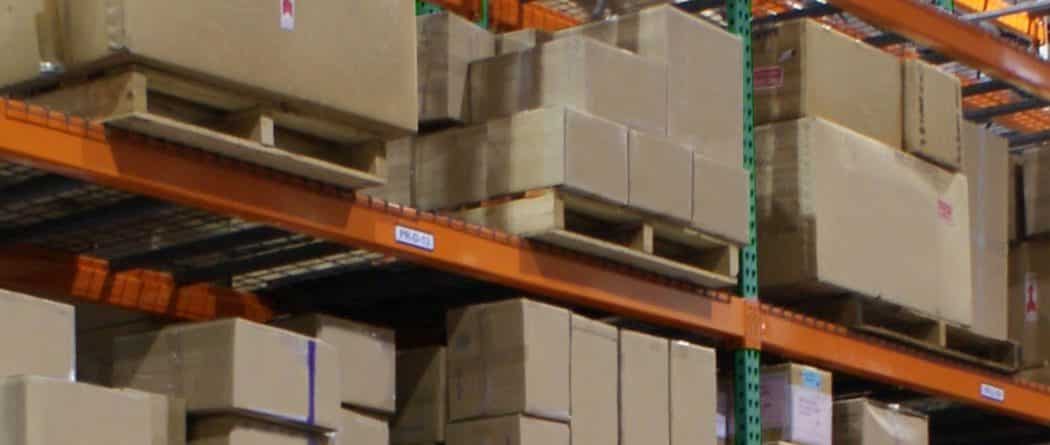
- Upright frames (or uprights): These are the vertical support columns that form the backbone of the rack system. An upright frame consists of two posts connected by horizontal and diagonal bracing to create a rigid, stable structure. They come in standard heights and depths to accommodate your facility’s dimensions and pallet sizes.
- Beams: These are the horizontal, load-bearing members that connect the upright frames. Beams create the shelf levels where pallets are stored and are designed to support the full weight of your inventory. Teardrop-style connections are the industry standard because they create a secure, gravity-fed locking mechanism that doesn’t require bolts, making it easy to adjust beam heights without special tools. Lyon’s step beams are designed to hold accessories like wire decking, and our teardrop design is compatible with many other major brands, offering flexibility.
- Baseplates (footplates): Located at the bottom of each upright post, these steel plates are anchored directly to the concrete floor. Baseplates are important for distributing the load and giving the entire racking system secure stability.
View our individual pallet rack components to build the exact unit for your space!
Important racking accessories

- Wire decking: Wire mesh decking sits on top of the pallet rack beams, creating a flat, supportive shelf surface. Its open design improves safety by allowing light from overhead fixtures and water from sprinkler systems to pass through to lower levels.
- Pallet supports: These are crossbars that span between the front and back beams, providing extra support for heavy pallets or non-standard pallet sizes. They help prevent pallets from falling and distribute the load more evenly across the beams.
- Row spacers: When you have back-to-back rows of pallet racking, row spacers are used to connect them. These components ensure the rows are kept at a uniform distance apart, adding stability and rigidity to the overall structure.
- Wall ties: Similar to a row spacer, a wall tie is used to secure a single row of racking to an adjacent structural wall, providing additional lateral stability. This is often required by local codes.
- Impact Guards: These heavy-duty steel guards are anchored to the floor at the base of uprights, especially at the end of aisles. Their primary function is to protect the racking system from accidental and costly damage from forklift collisions.
Shop our pallet rack accessories to enhance and secure your units.
Types of industrial pallet racking systems: a comprehensive comparison
Choosing the right type of racking is key for maximizing your warehouse efficiency. Each system offers a different balance of storage density, pallet accessibility (selectivity), and cost. The best choice depends entirely on your inventory, throughput, and operational goals.
Master comparison chart
| Racking Type | Storage Density | Selectivity | Cost Index | Inventory System | Ideal Application |
| Selective | Low | 100% (High) | $ | FIFO | High SKU diversity, fast access needs (retail, 3PL) |
| Double Deep | Medium | 50% (Medium) | $$ | LIFO | Large quantities of the same SKU, moderate access |
| Drive-In / Drive-Thru | High | Low | $$$ | LIFO / FIFO | Homogenous products, low turnover (cold storage) |
| Push Back | High | Medium | $$$$ | LIFO | Multiple SKUs needing higher density than selective |
| Pallet Flow | Very High | Low | $$$$ | FIFO | Date-sensitive goods (food & beverage), order picking |
| Cantilever | Varies | High | $$$ | N/A | Long, bulky items (lumber, pipes, furniture) |
1. Selective pallet racking
Description: Selective racking is the most common, versatile, and cost-effective type of pallet racking system used in warehouses today. It is often referred to as “Teardrop Pallet Rack” due to the shape of the punch-outs on the uprights that connect to the beams.
How it works: This system provides direct, unimpeded access to every single pallet from the aisle, making it simple to load and unload inventory.
Key characteristics:
- Storage Density: Low
- Selectivity: 100% (High)
- Inventory System: FIFO (First-In, First-Out)
- Cost Index: $
Best applications: This system is ideal for warehouses with a high diversity of SKUs, a low volume of pallets per SKU, and a need for fast, immediate access to products. You can commonly find it in retail distribution centers, third-party logistics (3PL) facilities, and general manufacturing.
Advantages:
- Low initial investment per pallet position.
- Total and immediate accessibility to every pallet.
- Flexible enough to handle various product sizes and weights.
- Simple to install, reconfigure, and adjust.
Disadvantages:
- Requires significant aisle space for forklifts, resulting in the lowest storage density of all systems.
2. Double deep pallet racking
Description: A variation of selective racking, this system consists of two rows of standard racks placed back-to-back, doubling storage capacity in a single run.
How it works: A specialized deep-reach forklift is required to access the rear pallet, placing it behind the front pallet.
Key characteristics:
- Storage Density: Medium
- Selectivity: 50% (Medium)
- Inventory System: LIFO (Last-In, First-Out)
- Cost Index: $$
Best applications: This system is well-suited for facilities storing large quantities of the same SKU where 100% selectivity is not a key requirement.
Advantages:
- Increases storage capacity by up to 50% compared to selective racking within the same footprint.
- Offers a good compromise between storage density and pallet selectivity.
Disadvantages:
- Requires specialized deep-reach material handling equipment.
- Reduced pallet accessibility, as the front pallet must be moved to access the rear one.
3. Drive-in & drive-thru pallet racking
Description: A high-density storage system that allows forklifts to drive directly into the racking structure to store and retrieve pallets.
How it works: Pallets are stored on rails that run the full depth of the rack. A Drive-In system uses a single entry and exit point, operating on a LIFO basis. A Drive-Thru system has separate entry and exit points, allowing for FIFO inventory rotation. The depth of these systems is limited by the forklift’s ability to safely maneuver within the structure, typically ranging from two to ten pallets deep.
Key characteristics:
- Storage Density: High
- Selectivity: Low
- Inventory System: LIFO (Drive-In), FIFO (Drive-Thru)
- Cost Index: $$$
Best applications: Drive-in racking is perfect for storing large volumes of homogenous, non-perishable products with low turnover rates. It is commonly used in cold storage freezers and for seasonal goods.
Advantages:
- Provides exceptional space utilization by minimizing the number of aisles needed.
- One of the most space-efficient pallet storage systems available.
Disadvantages:
- Very low product selectivity.
- Slower to load and unload pallets compared to selective systems.
- The structure is more susceptible to damage from forklift collisions. Reinforced uprights and heavy-duty post protectors are strongly recommended for these systems.
4. Push back pallet racking
Description: A high-density system that uses nested carts riding on inclined rails to store pallets two to six deep.
How it works: When a forklift operator loads a new pallet, it gently “pushes back” the pallets already in the lane. When a pallet is unloaded from the front, the rear pallets automatically flow forward to the picking face.
Key characteristics:
- Storage Density: High
- Selectivity: Medium (operators can access any lane, but only the front pallet in that lane)
- Inventory System: LIFO (Last-In, First-Out)
- Cost Index: $$$$
Best applications: An excellent solution for facilities with multiple SKUs that need higher density than selective racking but better selectivity and operational speed than drive-in racking.
Advantages:
- Combines high-density storage with good product selectivity at each lane level.
- Faster to operate than drive-in racking because forklifts do not enter the rack structure.
- Each level can store a different SKU.
Disadvantages:
- Higher initial cost per pallet position.
- Limited depth, typically between two and six pallets per lane.
5. Pallet flow racking (gravity flow)
Description: A high-density system where pallets are loaded from a rear aisle and flow down inclined rollers to an unloading aisle at the front.
How it works: This system uses gravity to move pallets forward. Integrated braking systems control the speed of the pallets as they move along the rollers, ensuring a safe and controlled flow.
Key characteristics:
- Storage Density: Very High
- Selectivity: Low (only the front pallet of each lane is accessible)
- Inventory System: FIFO (First-In, First-Out)
- Cost Index: $$$$
Best applications: Pallet flow is ideal for date-sensitive products like food and beverages, pharmaceuticals, or any operation that requires strict FIFO inventory rotation. It also excels in high-volume order picking environments.
Advantages:
- Automatically enforces a strict first-in, first-out inventory rotation.
- Separates loading and picking aisles, which improves efficiency and reduces forklift congestion. This “decoupling” of loading and unloading tasks allows dedicated teams to work simultaneously without interference, significantly reducing labor costs and streamlining the entire fulfillment process.
- Delivers exceptional storage density.
Disadvantages:
- Requires a significant capital investment.
- Requires consistent, high-quality pallets to function properly and prevent jams.
6. Cantilever racking
Description: A specialized system specifically engineered to store long, bulky, or irregularly shaped items that cannot be stored on standard pallets.
How it works: Cantilever racking uses a central column with arms extending outwards to create unobstructed, open horizontal storage levels. There are no vertical frame posts at the front to interfere with loading or unloading.
Key characteristics:
- Storage Density: Varies by application
- Selectivity: High
- Inventory System: N/A (item-based)
- Cost Index: $$$
Best applications: This is the go-to solution for storing materials such as lumber, pipes, steel bars, furniture, and rolls of carpet.
Advantages:
- No vertical obstructions in the storage bay, making it easy to handle long loads.
- Arms are highly configurable for different lengths and load capacities.
- Easily handles loads of varying and inconsistent lengths.
Disadvantages:
- Not suitable for storing standard pallets.
- Often requires wide aisles to accommodate the long materials being handled.
How to choose the right pallet racking system for your warehouse
Selecting the right pallet rack system is a strategic decision that directly impacts your facility’s productivity and profitability. To make the best choice, you need to analyze your unique operational needs.
Step 1: Analyze your inventory characteristics

- SKU diversity & volume: Do you store many different products (high SKU count) with only a few pallets of each, or do you store large quantities of just a few products? High SKU diversity favors selective racking, while high volume favors density-focused systems like drive-in or pallet flow.
- Pallet dimensions & weight: You must know the standard size, weight, and height of your loaded pallets. This information is key for engineering the correct beam capacity and upright dimensions.
- NOTE: 42″deep pallet rack is the most popular! The most commonly used pallets are 48″ deep. Using a 42″deep rack allows the pallet to rest on top of both beams without the need for extra decking. This is also referred to as “Ledge Loading.”
- Product throughput: How quickly does your inventory turn over? Fast-moving products require systems that allow for rapid access and high efficiency, such as selective or pallet flow racking.
Step 2: Evaluate your warehouse operations & space
- Inventory management system (FIFO vs. LIFO): Is product shelf-life or spoilage a concern? If so, you must choose a FIFO system like pallet flow or drive-thru. If not, a LIFO system like push back or drive-in can provide greater density.
- Warehouse layout & dimensions: You should measure your available floor space, but don’t forget to consider vertical space. Ceiling height, the location of support columns, and placement of doors will all influence your layout and system choice.
- Material handling equipment: The type of forklifts you use is a key factor. A standard counterbalance forklift requires wide aisles, while a narrow-aisle reach truck allows for a more compact layout. Ensure your chosen racking system is compatible with your existing equipment.
Step 3: Define your budget & calculate ROI
- Initial investment: The cost per pallet position is a key metric for comparing systems. While selective racking has the lowest upfront cost, high-density systems can offer a lower cost per pallet stored when space is limited.
- Long-term value: The right system delivers a strong return on investment by improving operational efficiency, reducing labor costs, preventing product damage, and making the most of your existing warehouse footprint.
- The Lyon advantage: When evaluating your total cost of ownership, consider the durability and longevity of your investment. All Lyon pallet racking is proudly manufactured from high-quality steel ensuring you get a system that’s built to last.
Steel racking construction: roll-formed vs. structural
Pallet racking is manufactured using two primary methods, each offering distinct advantages for different applications.
Roll-formed steel racking
- Description: This is the most common type of pallet rack construction. It is made from coils of cold-rolled steel that are passed through a series of rollers to form the components. Roll-formed uprights typically feature a teardrop punch pattern, which allows for easy, boltless adjustment of the beams.
- Pros: More affordable, easier and faster to install, and simple to adjust beam levels as your needs change. It’s ideal for most standard warehouse, retail, and distribution applications.
- Cons: Less resistant to damage from forklift impacts compared to structural steel.
Structural steel racking
- Description: This heavy-duty racking is constructed from hot-rolled structural steel channels, similar to the I-beams used in building construction. The components are typically bolted together to create an extremely strong and rigid frame.
- Pros: Exceptionally durable, highly resistant to forklift impact damage, and offers higher load capacities.
- Cons: Higher initial cost and a more labor-intensive installation process.
Best applications: Roll-formed pallet racking is the ideal choice for a wide range of warehouse and storage environments, particularly where flexibility and cost-efficiency are top priorities. It excels in operations that require frequent reconfiguration, such as retail distribution centers, e-commerce fulfillment warehouses, and small-to-medium-sized storage facilities, since its components can be adjusted without special tools or welding. Roll-formed systems are best suited for storing light-to-medium weight loads (typically up to 25,000 lbs per bay) making them perfectly adequate for the majority of standard palletized goods. If your operation involves a controlled indoor environment, standard floor conditions, and the need to scale or reorganize your storage layout over time, roll-formed racking delivers exceptional value without sacrificing functionality. It’s the smarter, more economical option when heavy-duty structural capacity simply isn’t required. Lyon offers several pre-designed pallet rack units that are in stock and ready to ship.
Pallet rack safety, inspection, and compliance
A safe warehouse is an efficient warehouse. Maintaining the integrity of your pallet rack system is not just a best practice—it’s vital for protecting your employees, inventory, and equipment.
Key safety practices
- Load capacity: Never exceed the manufacturer’s stated load capacity. It’s critical to distinguish between beam capacity (the maximum weight a pair of beams can hold) and upright frame capacity. Upright capacity is more complex, as it depends on the vertical distance between beam levels, known as the “unsupported span.” The greater the distance between levels, the lower the upright’s capacity. A qualified engineer must calculate the total system capacity, and capacity labels should be clearly posted. If labels are missing, contact an expert before loading.
- Proper loading: Ensure all pallets are centered on the beams, stable, and in good condition. An improperly loaded pallet can create a serious safety hazard.
- Proper anchoring: Proper anchoring is non-negotiable for safety and stability. The size and type of anchor bolts used depend on the thickness and quality of the concrete slab. A “pull test” may be required to verify the concrete’s integrity before installation.
- Operator training: Proper training for forklift operators is the single most effective way to prevent accidents and rack damage. Ensure all operators are certified and understand safe loading and unloading procedures.
Regular rack inspection
- What to look for: Create a routine inspection checklist. Key items include looking for damaged or dented uprights, visibly deflected or bent beams, missing or damaged safety clips, and checking that all baseplates remain securely anchored to the floor.
- Inspection frequency: We recommend that your trained staff perform regular visual inspections. A thorough, professional inspection should also be conducted at least once a year.
- Industry standards: Always adhere to the standards set by the Rack Manufacturers Institute (RMI). RMI is the authority on rack system design, testing, and safety standards in North America.
Frequently asked questions (FAQ)
Pallet racking is a heavy-duty system designed to store palletized loads that are handled by forklifts. Industrial shelving, like Lyon’s 8000 Series, is designed for storing lighter, non-palletized items that are typically picked and placed by hand.
The cost varies significantly based on the system type, capacity, configuration, and current steel prices. As a general guide, selective racking may cost $20-$40 per pallet position, while a high-density system like Push Back could be over $150 per position. We recommend you contact a Lyon solutions expert for a precise quote tailored to your specific needs.
While it is possible for small, simple systems, we strongly recommend using a professional installation team. Professional installers ensure your racking is assembled correctly, plumb, level, and securely anchored to comply with safety standards. Lyon’s nationwide network of distributors can connect you with experienced and qualified installation teams in your area.
Used racking can seem like a cost-effective option, but it comes with significant risks. You often don’t know its load history, there may be hidden damage, and it likely won’t come with a warranty. New Lyon racking is engineered specifically for your application, is guaranteed to meet current safety standards, and comes with a warranty for long-term value and peace of mind.
Partner with Lyon for your industrial storage needs
Choosing the right pallet racking system is an important investment in the efficiency, safety, and future growth of your facility. With so many options, having an expert partner can make all the difference.
Use our expertise as America’s leading steel manufacturer. For over 125 years, we’ve helped thousands of businesses organize their space and improve their workflow. Our team of 20+ solutions experts nationwide is ready to help you design the perfect system to meet your unique challenges. You can rely on the durable, American-made quality of our products, proudly built in our domestic plants. Everything in its place so you can keep on working.