

The Ultimate Guide to Custom Steel Workbenches
A steel workbench is the backbone of any workshop, warehouse, or maintenance department. Unlike wood or plastic alternatives, a heavy duty steel workbench holds up to daily impact, chemical exposure, and thousands of pounds of load without warping or breaking down. Whether you’re outfitting a single repair station or building out an entire warehouse workstation layout, this guide walks through everything you need to design, assemble, and maintain a custom steel workbench built to last.

Understanding Steel Workbenches
Types of Steel Workbenches
Not every job needs the same setup, which is why steel work benches come in several configurations. A basic metal workbench with a painted steel top works well as a simple shop table for light assembly or inspection. For heavier jobs, an adjustable-height steel top workbench lets you tailor the surface height to the task and the worker. If you need built-in tool storage, a modular industrial workbench with drawers combines a work surface with a full drawer cabinet underneath. And for teams that move between stations, a mobile workbench on casters brings the bench to the work instead of the other way around.
Benefits of Heavy Duty Workbenches
A heavy duty industrial workbench pays for itself through durability alone. Steel resists dents, chemical spills, and heat far better than laminate or wood, and some Lyon workbenches can support up to 5,000 lbs, which matters for engine teardown, fabrication, or parts staging. Beyond strength, a properly configured heavy duty workstation improves workflow. Drawers, shelves, and risers keep tools and fasteners within arm’s reach, cutting down on the walking and searching that eats into productive time on a shop floor.
Common Uses for Steel Workbenches
Steel work benches show up anywhere precision and durability matter. Automotive shops use them for engine and transmission work, with a shop top surface that’s resistant to chemicals and impact.

Warehouses use them as packaging work tables and packing stations workbenches for order fulfillment, often paired with a lower shelf to keep boxes and supplies close at hand.
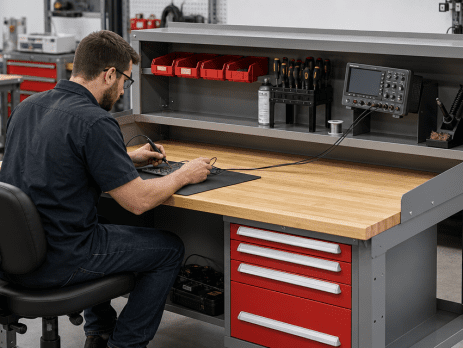
Electronics assembly and repair teams often add hardwood-top benches for a forgiving work surface, and manufacturing plants use benches as factory workbench stations along the production line. Because the frame and top can be configured independently, the same base workbench can be adapted to a wide range of industrial bench applications.
Essential Features of a Custom Steel Workbench
Designing Your Heavy Duty Workstation
Start by mapping out the actual task the bench needs to support. A single-person assembly station has different needs than a shared warehouse workstation table used by a rotating crew. Think through how tools will be stored, whether the worker will sit or stand, and how much clearance is needed for materials moving in and out. Lyon’s adjustable-leg workbench is a good starting point for most builds since the height, top material, and add-ons can all be selected separately.
Choosing the Right Dimensions
Height matters as much as footprint. A fixed-height bench sits at a standard working height, while an adjustable frame lets you dial in the ideal working height for standing, sitting, or shared use between different-sized workers. If floor space is tight, narrower shop tables or mobile carts make better use of a crowded work area than a single oversized bench.
Selecting Appropriate Materials
The top surface is where material choice matters most. A painted steel top provides a durable, resilient work surface built to withstand heavy use in industrial environments. A shop top is engineered to resist chemicals, impact, and heavy use, making it a strong pick for automotive or industrial repair work. For a more traditional look, a hardwood top at 1-¾ inches thick with rounded edges gives a sturdy, forgiving surface that some assembly teams prefer over bare metal.
Components of a Steel Workbench
Work Table Drawers
Work table drawers turn a flat surface into an organized station. A locking drawer provides secure and easily accessible storage for tools and small items. For teams that need more capacity, pairing a bench with a full modular drawer cabinet creates a work bench cabinet setup with dedicated storage for larger tools and inventory. For electronics or static-sensitive work, Lyon also offers conductive ESD bins that fit inside modular drawers to protect sensitive components from static discharge.
Adding Shelving and Cabinets
Vertical space is easy to overlook, but it’s some of the most useful real estate around a bench. A lower shelf keeps larger items within reach and off the floor, while a riser creates an additional tier for extra workspace or display. Combining shelving and workbenches this way is one of the most effective ways to add storage without adding square footage. For larger-scale storage needs alongside the bench, an industrial storage cabinet rounds out the workstation.
Configuring Workspace Ergonomics
Ergonomic industrial workstations reduce fatigue and injury risk over a full shift, which matters most on precision work like electronics assembly and repair.
Back and end stops help enhance safety and keep items from rolling or falling off the worksurface. Pairing the bench with the right seating, whether that’s a sit-stand stool perfect for assembly and repair work or a standard drafting-style chair with a backrest, keeps the workplace bench comfortable for extended use rather than just functional.
Tools and Resources for Building
Sourcing Steel and Components
Rather than sourcing raw steel and fabricating a frame from scratch, most shops start with pre-engineered components designed to fit together. Lyon’s workbench components line includes legs, stringers, tops, and add-ons, giving you the pieces to build or expand a custom industrial workbench. Both pre-engineered concepts and workbench kits built from these components feature hardwood tops with rounded edges.
Assembly
Lyon’s heavy-duty industrial workbenches and concepts are assembled on site, and can be built with the modular drawer cabinet on either the left or right side. Written assembly instructions for Lyon products, including workbenches, are available for download as PDFs in the assembly instructions library.
Maintenance and Care
Upgrades and Modifications
One advantage of a modular heavy duty steel workbench is that it can grow with your needs. Add a locking drawer as storage needs grow, add a lower shelf to keep larger items off the floor, or bolt on a riser for extra workspace or display. Lyon also sells replacement components, so individual parts like tops, legs, and stringers can be swapped or added on rather than replacing the whole bench.
Ready to configure your own setup? Browse Lyon’s full line of industrial workbenches, or request a quote and our team can help you spec out the right heavy duty steel workbench for your shop, warehouse, or production line.
